Tuesday, 22 June 2010

Just Do It - The Movie


Interesting stuff:

Just Do It is an exciting new feature documentary film that follows the mischievous and risky world of UK climate activists.

In early 2009, acclaimed documentary filmmaker Emily James began filming the clandestine activities of several groups of environmental civil disobedient activists in the UK. Allowed unprecedented access, her footage shows us the people behind the politics, providing the often overlooked human element to their story as we watch them take on the combined forces of global capitalism, run-away climate change and those pesky metropolitan police!

Their adventures will entertain, illuminate and inspire, whilst inciting you to get off your arse and change the world.

Currently in post-production and set for release in early 2011, Just Do It is a film pushing boundaries. It is an experiment in crowd-funding, group production and community-engaged documentary filmmaking. Read on to find out more…

Monday, 19 April 2010

The Tropic of Cancer, from Bangladesh to Burma


A few friends recommended this program to me and I found it quite alarming, but in a way it confirms what I know about the plight on the Chin people already, and reaffirms my burden for the people , and why I started the Burma Orphanage Project. Have a watch...

http://www.bbc.co.uk/iplayer/episode/b00s5wzp/Tropic_of_Cancer_Bangladesh_to_Burma
Simon Reeve continues his epic journey around the world following the tropic of Cancer, the northern border of the tropics region.

This episode takes Simon through Bangladesh and on a perilous covert journey into Burma, where western journalists are banned.

In Bangladesh, Simon sails down the mighty Padma River and visits fishermen who use trained otters to drive fish into their nets. Further on he sees the river banks crumbling before his eyes - increased river erosion is thought to be caused by global climate change - and in the capital Dhaka he meets some of the millions of child workers.

From North East India, Simon treks through jungles and across rivers into Burma to meet the Chin people - an ethnic group who are brutalised and oppressed by the Burmese government.

After travelling around the tropic of Capricorn and the equator, this series completes Simon's trilogy of journeys exploring the amazing tropics region with his toughest, longest, most ambitious challenge yet.

Monday, 5 April 2010

Are Christians Being Persecuted - A BBC documentary

For years now, some town halls have been renaming their Christmas Lights as Winter Lights festivals. More and more Christians are ending up in court, defending themselves against what they see as victimisation for not being allowed to wear a cross to work or to pray for a patient. Many Christians feel that Christianity - once the heart of British society - is being pushed to the margins.

Nicky Campbell investigates whether Christians are being discriminated against. He explores the effects of multiculturalism and asks Muslims whether they are offended by Christmas Lights celebrations. Campbell also analyses the impact of recent human rights legislation and the Equality Bill: do they promote a more or less tolerant society? A poll specially commissioned for the BBC reveals what the public think.

If the Christian faith is being sidelined from the public space, is that a good or a bad thing? Campbell interviews Christians who claim they have been discriminated against, as well as leading religious and secular voices, including Archbishop of Westminster Cardinal Vincent Nichols; Chief Rabbi Jonathan Sacks; Bishop of Rochester Michael Nazir Ali; Shami Chakrabati, Director of the civil rights organistation Liberty; and Polly Toynbee, President of the National Secular Society


http://www.bbc.co.uk/iplayer/episode/b00rx7tj/Are_Christians_Being_Persecuted/

Found this incredibly interesting. Thought some interesting points were made regarding the general push for tolerance in society, trumping tolerance of Christians and people of faith...

Monday, 29 March 2010

Wednesday, 24 March 2010

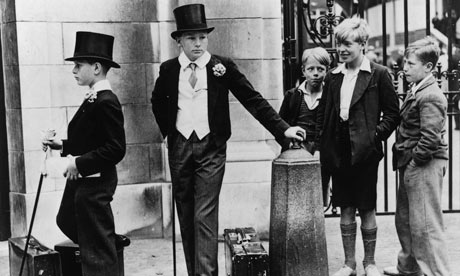
The photograph that defined the class divide


Something interesting for the History Buffs in the family:

In 1937, five boys were famously snapped standing outside Lord's. But who were they, what were they doing there – and what happened to them?

By 1937 Eton and Harrow had been playing each other at cricket for 132 years. Their annual match was, and remains, probably the oldest regular fixture in a game that has the richest and longest traditions of any team sport played with a ball. It lasted two days and attracted big crowds – over 30,000 during its Edwardian heyday. To use a violent modern image, a bomb dropped on this crowd would have obliterated many of the most powerful people in England.

Male spectators wore toppers and tails, and women their summer hats and frocks. The Harrovians and Etonians themselves came in their most formal outfits – "Sunday dress" as Harrow called it – which only a very able student of the English social system could differentiate. The pupils at both schools wore, with minor variations in style, the clothes that at some point in the 19th century had become the uniform of the well-dressed English gentleman: a top hat, a tail coat, a silk waistcoat, a cane.

On the morning of Friday 9 July 1937, Peter Wagner and Thomas Dyson stood dressed in this way outside Lord's. They were Harrow pupils, aged 14 and 15, and this was the opening day of the match. The event had lost some of its social eminence in the years since the great war, but the crowd strolling into the ground that morning was still large and smart. Local boys, porters for the day, unloaded wicker hampers from spectators' cars and carried them into the stands. There were quite a few photographers about. But where in this melee was the Wagner family: Peter's father, mother and older sister?

The Wagners had made an arrangement. Peter and his friend Dyson (known as Timmy or Tim) would come down from Harrow with their cases packed so that, after the day's play was over, they could go straight to the Wagners' Surrey house for the weekend. A little before the match started at 11am, the two boys would meet the Wagner party at the Grace Gates. There could be no mistaking the rendezvous: the Grace Gates were easily the most splendid entrance to Lord's, remodelled in the previous decade to honour the memory of the legendary Victorian cricketer. This was also the first entrance that the Wagners, motoring east up St John's Wood Road, would see.

The two boys waited, the minutes ticked away. No sign of the car. Peter had started at Harrow barely three months before, at the beginning of the summer term; Tim had arrived the previous year. They were in different forms and different houses – Peter at The Park and Tim at West Acre. Peter was the smaller and the younger and also, perhaps, the cleverer boy, because he had won a scholarship and Tim had not. They knew each other through their parents, who had met on a cruise. We can speculate that waiting gave Peter more anxiety. Now the burden of responsibility (his parents, their lateness) made him turn his back on Tim and stare westwards down the likely route his parents' car would take....

More from The Guardian.